
Water Resistance Testing
Water Resistance Testing in Super Clone Watches: What to Expect
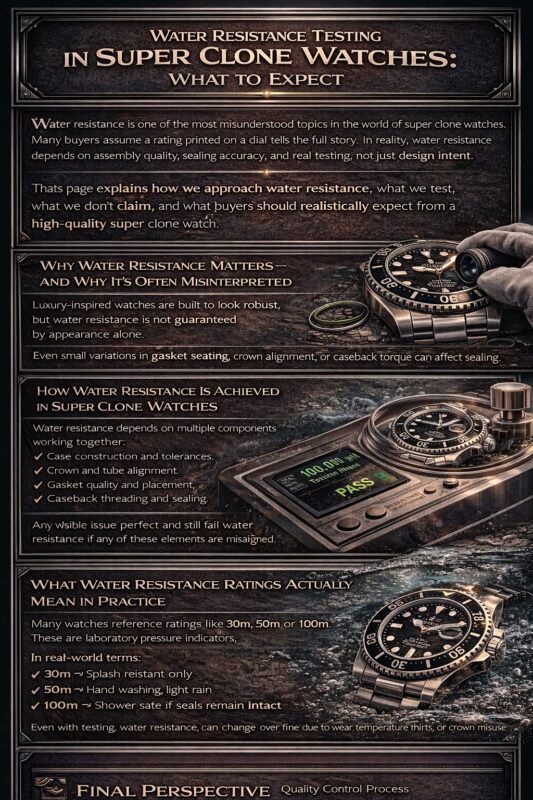
Water resistance is often misunderstood in the world of super clone watches. Many buyers assume that the rating printed on a dial tells the full story. In reality, water resistance depends on assembly quality, gasket integrity, and inspection standards rather than numbers alone.
How Water Resistance Is Achieved in Super Clone Watches
Proper water resistance requires multiple components working together:
- Case construction and tolerances
- Crown and tube alignment
- Gasket quality and placement
- Caseback threading and sealing
- Crystal seating and pressure fit
A watch can look perfect yet fail water resistance if any of these elements are misaligned. This is why case construction and sealing craftsmanship play a critical role in real-world performance.
Our Water Resistance Testing Process
We do not rely on factory claims. Each watch undergoes a controlled quality control inspection process before shipment.
Step 1: Visual Seal Inspection
- Crown threading smoothness
- Crown seating against the case
- Caseback gasket condition
- Crystal seating integrity
Step 2: Case Closure and Torque Check
The caseback is secured to proper tension. Over-tightening can damage gaskets; under-tightening compromises sealing. Balance is critical.
Step 3: Pressure-Based Water Resistance Testing
- Air pressure response
- Case deformation behavior
- Seal consistency under mild pressure
This step confirms the watch is sealed properly at the time of inspection.
What Water Resistance Ratings Mean in Practice
Common ratings like 30m, 50m, or 100m indicate laboratory pressure tolerance, not guaranteed real-world performance:
- 30m → Splash-resistant only
- 50m → Hand washing, light rain
- 100m → Shower-safe if seals remain intact
Resistance can change over time due to wear, temperature changes, or crown misuse.
Safe vs. Unsafe Practices
Safe Exposure
- Hand washing
- Light rain
- Accidental splashes
What to Avoid
- Swimming
- Hot showers or saunas, which can affect mechanical movement sensitivity
- Diving or prolonged submersion
- Water exposure with unscrewed crowns
Why We Avoid Overstating Water Resistance
Some sellers advertise extreme water resistance without verification. This often ignores differences in factory-level assembly standards, long-term gasket wear, and real usage conditions.
- Gaskets wear over time
- Testing reflects only a moment, not long-term use
- Buyer trust is more important than exaggerated claims
Maintaining Water Resistance
- Keep the crown fully secured at all times
- Avoid hot water environments
- Have seals checked periodically by a watch technician
- Treat water resistance as a protective buffer, not a guaranteed feature
Final Perspective
Water resistance in super clone watches is real, measurable, and testable — but it is not absolute. Proper assembly, honest verification, and realistic usage are what truly matter. These principles reflect our inspection standards for super clone watches as a whole.